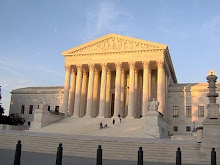
In class Thursday, Rich Gordon spoke to us via teleconference about the exciting possibilities the Internet offers journalism. The entire point of the class has been to study how we can use computers and the Internet to enhance our reporting. In today's morning e-mail from Poynter, there was a link to a great investigative series from the St. Louis Post-Dispatch that exemplifies how multimedia can enhance a story. The series looks at the number of fugitives nationwide who are free (and some of them still committing crimes) because states don't enter warrants into the FBI's fugitive database. The online version of the series is packaged together with breakouts of the data, a section on how the series was done, and videos and graphics. It also has an interesting feature that places pictures of some of the fugitives below a map of the U.S. that traces the path of each fugitive throughout the country. The content of the stories is fascinating (and scary), but the package is noteworthy because of how well it utilizes the types of tools newspapers are now embracing.
Monday, March 17, 2008


Friday, March 14, 2008
The new era of journalism

In Thursday's class, we spoke with Rich Gordon, a professor at the Medill School of Journalism at Northwestern University. Gordon talked about the way technology is changing the newspaper industry. We had read an article Gordon wrote several years ago for Online Journalism Review in which he asserts that technological development makes it an exciting time to work in journalism. In his conference call with us, Gordon said that what matters right now is not whether the big corporations survive the changes in the industry, but whether journalists can continue to provide citizens with the information they need for a democratic society to function.
He pointed out that while sales and circulation of papers are down, the Internet is not to blame because circulation has been flat for decades. It is the business model of daily print papers that is deteriorating and in fact, more people are reading the news than ever before, he said. I hope this is true, but I am still going down kicking and screaming. I love what the Internet can do for journalism, and I love knowing that people around the world can read my work, but for me, nothing will replace the experience of spreading the real newspaper out in front of me and reading while drinking a cup of tea (usually having to stop every few minutes because the cat is lying on the paper).
As we did in last week's teleconference with Mark Briggs, we discussed the way our generation will be affected by these new technologies. Gordon said that it will be today's students (and graduates) who will develop new business models and new jobs within the industry. Like Briggs, Gordon said that the key for us is to have the skills for entry-level reporting and editing jobs but also be adaptable to learn the new tools of the industry. ...
Without even being asked, Gordon did acknowledge the one thing that makes me anxious when I hear people who are working in the industry (or who, like Gordon, are now teaching) talk about what is happening in the industry now. It's easy for those people who have jobs to say that this is an exciting time for journalists. I agree that there are exciting possibilities. It is not, however, an exciting time to be looking for newspaper jobs. I'm sure they're out there, and I am confident in my abilities; but it's scary to hear people talk about the decline of the industry. I remember being at my internship in Washington, D.C., and joking with my boss about how we'll all wind up working at a certain "big box" store when the industry crashes. My response was that if I can't be a journalist, I'll get a doctorate and become an English professor. All that being said, I'm encouraged to hear that not everyone thinks the future is so bleak. I hope Gordon is right in his assertion that keeping journalism alive is all a matter of developing new business models. I just hope the public is on board and continues to ask for (and respect) the type of journalism that I want to do.
Monday, March 10, 2008
"Crowd Sourcing"
A second article we read in class this week, by Emily Yahr, discussed "crowd sourcing," the practice of asking readers/viewers to send in their own stories about what is happening. The author of the article linked above writes about the Des Moines Register's use of crowd sourcing to find out where people were when the Interstate 35 W bridge in Minnesota collapsed. On this blog, I've linked the Minneapolis Star-Tribune's interactive feature in which you can read the stories of the people in every car on the bridge that day. This information was gathered in part through the type of crowd sourcing discussed in Yahr's article. The main page contains a link asking visitors to the site to help the paper fill in the missing details. You can listen to the audio interviews with several of the survivors and read about the lives of the victims.
Even before I read Yahr's article, I thought of the Star-Tribune site. I think I've mentioned it before in reference to how technology can enhance reporting. Gathering information such as this while an event is happening can paint such a vivid picture afterward.
While I understand and share some of the concerns about people responding to inquiries not being honest about who they are, I think the Web and technologies such as cell phone videos can really enhance reporting and add real human elements to the story. Reporters often are present for the aftermath of a disaster, but being there right in the thick of things gives a much different picture of the story. Videos and posts sent right from the scene are so much more meaningful than interviews done after the fact, when the shock of things affects the memory of the subjects.
It's a beautiful day in the neighborhood

As a college journalist, I’ve spent the past two years writing extremely “localized” stories. With the exception of some city, state and federal political coverage, everything we publish must be relevant to students. With 20,000 students on a 295-acre campus, the University is like its own very large neighborhood. While the sight of a fire engine racing up the main street near my house is only mildly interesting, the sight on campus makes me stop what I’m doing to follow the truck and see what is going on.
After spending so much time looking for such narrow angles on my stories, the idea of “hyperlocal” reporting is intriguing. In the first class I took as a graduate student, we were assigned specific neighborhoods to explore; many of my classmates came up with really interesting stories simply by walking around areas such as the Trainsong or Whitaker neighborhoods.
In the article linked above, Donna Shaw talks about what happens when larger paper take on this idea. She quotes a man, who is working to develop this type of site for the Washington Post. This fascinates me, and I think a place like D.C. is the perfect example of where this type of reporting can get really interesting. ...
One of the things I loved about Washington, D.C., was the diversity between neighborhoods and the characters you ran into. I would love to find individuals in the different neighborhoods and learn about them.
I lived on Capitol Hill, across the street from the building Samuel Alito lived in during his Supreme Court confirmation hearings and just two blocks from the Capitol.  I was told that Barack Obama and John Ashcroft also lived in my neighborhood. About five blocks north of my apartment, a man named Peter Bis lives on a corner between a gas station and Union Station. At night, he moves down the block and campus out in front of a bagel shop. Peter is very friendly. He never asked me for money, but wished me a “Happy Monday” (or Tuesday, Wednesday, Thursday, etc.) every morning when I passed him on my way to work. He gave me a business card with the URL for a blog where he posts conspiracy theories about the government (A former D.C. intern has a great blog post about Peter ).
I would absolutely love to return to D.C. and sit down for some interviews with Peter. He is probably well-known to many people in D.C., but that is a man is truly IN a neighborhood. He sees everyone who passes through from Capitol Hill. He’s out there every day, on the street. He’s quite a fascinating character, and I considered him to be one of my neighbors. The experience of that neighborhood wouldn’t have been as rich without seeing a person like him everyday. I really do regret that I didn’t take the time to really sit down and talk to him.  What does it say that so close to the Capitol, there are people living on the street? The building I lived in was intern housing, but if I had to live in the District again, I’d want to live in the same area. When your neighbors include U.S. Senators and the occasional Supreme Court Justice, how do you interact and build relationships? .
Wednesday, March 5, 2008
"Journalism 2.0"

On Thursday, Mark Briggs, the assistant managing editor for interactive news at the Tacoma News Tribune and the author of "Journalism 2.0: How to Survive and Thrive: A digital literacy guide for the information age," spoke to our class via teleconference.
Briggs took questions from the class and discussed the importance of new journalists understanding the technologies that newspapers are beginning to adopt. While this is something we have been told by our professors for years, hearing it from someone working in the field makes me feel that all of the computer courses I have taken were worth the time and money.
Listening to Briggs talk about the importance of Internet skills made me think about the work I have done in journalism. When I began working on my high school paper as a freshman, the Internet was still new and exciting. Only the kids with really cool/rich parents had the Internet at home, always on the super-fast 14K dial-up modems of the day. The school I went to was years away from even having computers that could handle the Internet, let alone providing the service to students. We still did our page layouts the old-fashioned way — by printing out the pages and pasting the individual page elements onto the page dummies (While other students preferred plain Elemer's glue, my favorite was the clear rubber cement with the brush applicator). I remember how excited we were when the publisher began accepting our page proofs on a disk and the days of dealing with real scissors and paste were over. It amazes me to see how far the process has come in just the nine years since I finished high school.
And here is the rest of it.
Saturday, March 1, 2008
Media blackouts
Earlier this week, news broke that Prince Harry has been serving in Afghanistan with the British army and that the media knew about it but had agreed to withhold the story until after the deployment was over. He has since returned home from the mission because once the new broke, it was determined that it would not be safe for him to remain there. I'll admit that I saw the report about Harry on CNN while I was getting dressed Thursday morning and did not pay much attention. The news broke too late to make my paper edition of The New York Times, and frankly, I don't care much about the royal family, so I didn't read any of the stories online. Somehow, I missed the part of the CNN broadcast where they reported on the side of the story that should interest me as a journalist.
My classmate Kate posted about this on Thursday, which is what prompted me to go check the story out for myself (I haven't read the Drudge Report yet). I did head over to Poynter Online to see if the writers of "Everyday Ethics" had anything to say. I was happy to find that Bob Steele did write an article on the media's agreement with the miliatry . ...
Steele
brings up several things I did not know after reading about this only in passing. My biggest concern was whether the media should be revealing where Prince Harry was stationed, given the danger to his fellow soldiers (less of an issue now that he's returned home). Steele's focus is mainly on whether the media had justification for agreeing to withhold information for so long (four to six months).
Steele's main argument is something that I had missed. Apparently, the prince was deployed only AFTER the media agreed to keep it a secret, and the British military promised that the prince would be available for interviews that could be made public after his deployment:My primary concern is with the news organizations that played along with this secret deal.
Especially when you add in a revealing quid pro quo piece of the puzzle, any arguments for ethical responsibility further erode. In exchange for the media's silence, the British military agreed to provide the news organizations with favored treatment
As Satchwell wrote in The Guardian, “In return there would be special access for the media to the prince before, during and after his deployment which could be reported when he returned home, without any interference by the Royal family or the military except for reasons of operational security.”
Trading secrecy for access. That stinks.
It gets worse. More from Satchwell: “It was an extraordinary and rare display of unity for national and regional newspaper and magazine editors and broadcasters not to report the story.”
Unity? Hardly. It sounds more like a conspiratorial cabal.
Hiding behind false logic, the news organizations involved in this deal failed their readers and viewers and delivered a serious hit to the principle of journalistic independence.
So. The question is, is there ever a time at which journalists should agree to withhold a story for such a long period of time? I definitely agree with Steele that journalists should never come to such an agreement with any source, but I still think it is important to ask whether the public's right to know that the Prince is in Afghanistan outweighs the security risk posed by revealing the information.
I agree that the media's motives in making a deal are highly suspect, but would this be worse if the media had said "We care about the safety of the soldiers and we will not accept bribes, but we will withhold the story?" Journalists are never supposed to accept any type of gifts or special treatment from sources, but I wonder which is worse: the potential harm to those deployed with Prince Harry or the harm to the profession from "trading secrecy for access."
Getting the story
There's an interesting article on Vanity Fair's Web site about a reporter's quest to verify a claim that a man named Jack Worthington is John F. Kennedy's son . It's a fairly long story, most of which is devoted to explaining what the reporter went through trying to obtain information that would verify different aspects of the story, including whether or not Worthington's mother actually knew JFK. In this case, it didn't pan out because there was no way to obtain DNA samples from either JFK or the man who raised Jack Worthington — the reporter did obtain hair samples supposedly from JFK, but there was no way to prove that's what the were — but it's an interesting look at the process the writer went through chasing down the story.