It's been a busy two years. Short update: I've been working as a newspaper copy editor since 2008, but am now temporarily leaving the industry. I hadn't posted in a while because I wasn't sure what the newspapers' policies on blogging were, but now that my future is a tad uncertain, I'm definitely interested in using this blog as an outlet. I'm hoping to do some freelance writing and may post some of that here.
Tuesday, January 10, 2012
Thursday, May 28, 2009
Random stories of the day
I found a few interesting stories today that I thought I'd share. The first, from the American Journalism Review, discusses whether Twitter is just the latest techno-fad or can be used as a serious reporting tool.
The article does discuss the fact that may "tweets" are boring and/or useless (I'll admit that mine aren't always interesting); however, it does discuss the many ways in which the micro-blogging site can help reporters.
While I'm sick of the trend of older TV journalists (By that I mean those at least the baby boomer age) "discovering" Twitter and getting all excited about learning the new-fangled technology, I certainly appreciate the possible applications of Twitter as a reporting tool. The first photos of the crash of a plane into the Hudson were posted to Twitter, after all. Is most of the stuff on Twitter pretty useless? Probably. Is it depressing that more people follow Ashton Kutcher than CNN? Absolutely. CAN it be used as a reporting tool (both to find sources and to disseminate information) by journalists who know what they're doing and know the difference between useful information/links and crap? Definitely.
• This article I found today has some reaction to the story I posted a few days ago about that claimed the New York Times had tips about Watergate before the Washington Post but dropped the ball on the story. I'm not familiar with the site the story is on, but it's interesting.
• This story is several days old, but I'm going to post it anyway because it is another example in the debate over who qualifies as a journalist (and when). An unnamed student at San Francisco State University who was present on the scene of a murder refused to talk to police, claiming that journalism shield laws protect him because he was there as part of a photojournalism project for school.
It is a bit unclear whether the SFSU student was with the victim, who was a subject of the project chronicling life in the community, or if the student just happened upon the scene of the crime. But he knew the victim and called police and the victim's family after the murder. An LA Times column says police did confiscate the student's photographs and points out that courts have made it clear that journalism students are covered under shield laws. The student's lawyer, who is quoted in the LA Times column, says there is no evidence the student saw the murder happen. I am of the opinion that student journalists should have the same protection under shield laws as professionals, but the question of who should be protected and under what circumstances is an interesting one in an age where anyone can start a blog, take photos and claim to be a journalist.
Monday, May 25, 2009
Tough times
There's not much going on here. It's a tough time to be looking for work in journalism, particularly in newspapers. It seems that every time I consider giving up and looking to work for a different medium, something reminds me how exciting it can be to work at a newspaper.
A story in today's New York Times reports that during the Watergate scandal, the director of the FBI allegedly divulged sensitive information to a NYT reporter -- including the involvement of Attorney General John Mitchell as well as White House involvement -- before the Washington Post got the story.
The reporter in question had quit the paper and was leaving to attend law school but went back to the office and told an editor what he had heard. The editor took notes and recorded the conversation. But as we know, the Washington Post got the story first — from Mark Felt, then the number two man at the FBI ("Deep Throat") — and the Times never got the story.
It's rare that we hear about the story the paper didn't get, so it's interesting to look back on now. But what this does for me is remind me of what journalism is all about.
Watergate started out as a cops beat story. What seemed like just a break-in, only interesting because it happened to be at the Democratic headquarters, took down a president because a reporter (who happened to be friends with the number two man at the FBI) followed his instincts and looked into who the burglars were. The question today is, if that NYT editor had followed up on his reporter's tip all those years ago, how would the story be different?
Wednesday, April 22, 2009
Students do not shed their Constitutional rights ...
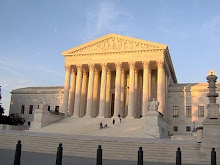
The Supreme Court is hearing an interesting case this week regarding students' rights to privacy. As a journalist, I'm of course interested in Constitutional law, but I'm particularly fascinated by how the Court defines students' rights. When I joined the staff of my junior high school newspaper, one of the first assignments was to read about some famous cases regarding student rights and we wrote a term paper on those cases. My interest in Constitutional law and the First Amendment is what made me want to become a journalist. When I first read about this case a year or so ago, I thought of the cases I studied all those years ago.
In Safford School District v. Redding, the issue is whether school officials were right to require a then-13-year-old girl to strip down to her bra and panties while investigating whether she had prescription ibuprofen in her possession. Another student was caught with 400 mg pills — a dose equivalent to two regular Advil. She told school officials she obtained the pills from Savana Redding, now 19.
Redding's backpack was searched and when officials did not find pills, they forced her to strip down and shake out her bra. She did not have the pills. Her parents were not present and they filed suit. The 9th Circuit Court of Appeals ruled the search to be unconstitutional. What's really interesting about this case is that there is no real precedent to guide the Court. In 1969, justices ruled in Tinker v. Des Moines that "students do not shed their constitutional rights at the schoolhouse gate" and that regulation of students' First Amendment rights is limited to situations in which the speech is disruptive to the educational process (In this picture: The armband worn by high school student Mary Beth Tinker to protest the Vietnam War). Some other cases, including Hazelwood East v. Kuhlmeier, which applies to regulation of student newspapers, have expanded the rights of school officials to limit speech.
The only ruling that applies to student's Fourth Amendment rights is TLO v. New Jersey. In the 1985 case, a student's purse was searched after she was caught smoking in a bathroom. School officials found marijuana, rolling papers, a large amount of cash, plastic bags and what appeared to be a list of students who owed the girl money. The police were called and the girl later sued, claiming the search was unreasonable. The Court upheld the search, saying school officials have the right to search a student without a warrant if there is reasonable suspicion that something in his or her possession would interfere with the officials' ability to keep the school safe ...
This case seems like a no-brainer, but today's news indicates the justices may be leaning toward an interpretation of the law that could drastically impede students' rights in the future. Justices seem to be leaning toward the idea that the type of drug is irrelevant to whether officials have the right to search a student. This could be an interesting re-interpretation of what constitutes a reasonable search.
In the case currently before the Court, school officials are arguing that the search was reasonable because of the need to keep other students safe.
School officials (and, it seems, some of the Supreme Court justices) defended their actions by claiming they need to protect students from the harmful effects of abusing prescription drugs. While this is of course something schools should do, I see several problems with the argument, not the least of which is that they were basing their search on a single student's story. First of all, if they were so worried that they thought she was hiding pills in her underwear, her parents should have been notified. Second, there was no immediate danger to Redding or other students if they waited for her parents to arrive. Third, there is a world of difference between the types of drugs that are abused and ibuprofen. It is not reasonable to believe that the possession of a non-narcotic pain reliever available over-the-counter poses such a threat to the school that any forced search of a student is Constitutional.
The ruling is expected in June.
Read more On "Students do not shed their Constitutional rights ..."!
Monday, April 20, 2009
2009 Pulitzer Prizes
This year's Pulitzer for feature writing went to Lane DeGregory of the St. Petersburg Times for a feature on an little girl who had been horribly abused and neglected by her mother. I was excited to learn that this piece won, because it was some of the most powerful reporting I've ever read and I haven't been able to forget it since I read it when it was first published last year.
The article, titled "The Girl in the Window," is very disturbing, and I wouldn't recommend reading it over breakfast, but is a fantastic piece and the reporter is absolutely deserving of the Pulitzer.
The prize for feature photography went to Damon Winter of the New York Times for his coverage of President Obama's campaign.
A list of the rest of the winners can be found here: http://www.pulitzer.org/awards/2009.
And here is the rest of it.
Saturday, April 4, 2009
Quick update
I never did get around to updating the situation at the Oregon Daily Emerald. Long story short, the strike ended and among other things that were agreed upon, the board decided to advertise the publisher's position nationally.
Today, I opened my job search email from journalismjobs.com and found this: http://tinyurl.com/djd5eh.
If I had the experience needed for this type of job, I'd apply in a heartbeat.
Monday, March 23, 2009
The journalist's lament
This weekend, I volunteered to mentor a teenager in a journalism workshop at my old paper. It's the seventh time they've done the workshop, in which high school students come in on a Friday night to hear a guest speaker and have dinner, then on Saturday morning go out and do interviewing and reporting for a story, which they write on Saturday afternoon. It's a pretty good crash-course in what it's like to be a reporter at a daily paper. My experience was a bit different.
The student I mentored was only in eighth grade, making her the youngest to ever to do the workshop. She had no previous experience, but was great to work with. She was enthusiastic and very willing to learn. We went out on Friday night — another first — and covered a DVD release party for "Twilight," which I know nothing about, but which she loves. The best part of the party was that while we both went in expecting a lot of girls her age, what we found was that women my age and older are really, REALLY into "Twilight." Our main characters were a group of women all wearing shirts that read, "Over 30 and dazzled," with pictures of the male lead in the movie on the backs. They were VERY excited about the movie and more than willing to talk about it. When we came back in the morning, we wrote during the time other students were out doing their reporting, so we had time to do a second story. We went out to do a quick piece on a giant yard sale to raise money for the graduation party at one of the high schools. Doing a second story was yet another first for my student. It was a blast, and the photographers on both stories were so great. The photo and story from the "Twilight" party were so good that package wound up running as the centerpiece on today's "Homefront" (what would be the city or metro section in a bigger paper) section.
The weekend was a blast, my student was awesome, and it was great to see so many young people interested in journalism. I don't know how many of them are interested in doing it as a career, but it's still exciting.
For better or for worse, going around with my student helping her interview and write just solidified my determination to stay in journalism. On one hand, it's nice to feel so passionate about something, on the other, the news about daily papers just keeps getting worse and worse. At this point, even if I found a job, there's very little job security. Even a paper that appears to be doing well could make cuts in a few months in order to try to get ahead of the storm. I've decided to move back in with my parents, which will allow me to save my unemployment checks instead of budgeting every cent while I look for something new. Taking away that stress will make it easier to be a bit pickier, but will give me time to look into other options. If nothing else, I'll freelance on the side. I'm already doing a bit of freelance editing and have been accepted to some freelance writing Web sites. I just need to DO the writing. Hopefully it won't take too much longer to find the right job.